
BT9G LABS / DHT Deep Dive #06
Inside a DHT Routing Table: k-Buckets, Node Churn, and Contact Selection
How k-buckets organize DHT contacts, why stable nodes matter, and how routing tables behave under churn.
BT9G Labs / DHT Deep Dive #06. How k-buckets organize DHT contacts, why stable nodes matter, and how routing tables behave under churn.
Quick summary
- Topic: Inside a DHT Routing Table: k-Buckets, Node Churn, and Contact Selection
- Core keywords: k-bucket, routing table, DHT nodes, Kademlia routing, node churn
- Audience: backend engineers, protocol researchers, search engineers, and BitTorrent implementers
- Goal: explain the mechanism accurately enough to support real crawler and indexing architecture decisions
System view
Distance bands instead of one giant list
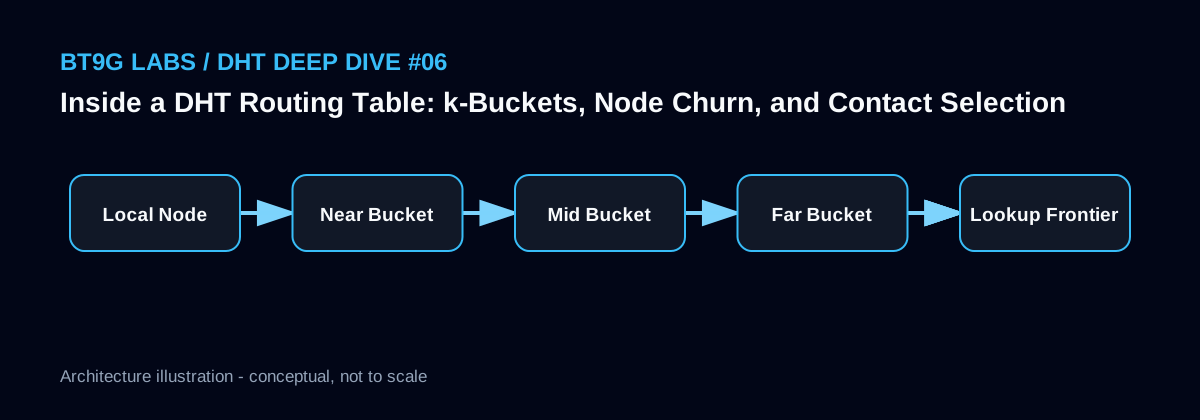
A DHT node does not maintain every participant. It keeps a bounded set of contacts organized by identifier distance. Kademlia calls these groups k-buckets. Each bucket covers a distance range that is exponentially wider than the previous one.
This structure concentrates precision around the local node's own region of the key space while preserving a sparse map of distant regions. That is enough to route a lookup because each hop can reveal contacts with a better prefix match to the target.
Why old responsive nodes are valuable
The original Kademlia algorithm prefers a long-lived responsive contact over a newly discovered node when a bucket is full. The reasoning is operational rather than sentimental: a node that has already survived for a long time is a useful candidate to remain available.
When the least-recently seen entry is challenged and still responds, it can be kept. If it fails, the new contact may replace it. This policy naturally resists routing tables made entirely from short-lived arrivals.
Refreshing and splitting
Implementations periodically refresh stale distance ranges so the table does not freeze around dead contacts. Bucket splitting rules vary by implementation, but the objective is consistent: keep enough live contacts in useful regions without allowing the table to grow without bound.
Crawler implementations often maintain additional metadata such as last-seen time, failure count, RTT, source, and validation status. Those fields are local engineering aids; they are not part of the BEP 5 compact-node representation.
A routing table is a cache, not truth
Internet churn makes every routing table incomplete and temporary. Nodes disappear, addresses are reassigned, and NAT behavior changes. Good systems therefore age observations and continually repair routing state.
For analytics, it is useful to separate the active routing table used for queries from a historical node-observation store used for research. Mixing them can cause stale historical data to leak back into the hot path.
Implementation sketch
type Contact struct {
    ID        [20]byte
    IP        net.IP
    Port      uint16
    LastSeen  time.Time
    Failures  uint8
    RTT       time.Duration
}
Engineering notes for BT9G Labs
For an indexing system, protocol correctness and data semantics matter more than raw event volume. Keep durable content identity separate from volatile peer observations, retain timestamps on measurements, and make every network-derived field explicit about its source. This prevents the search layer from turning a short-lived observation into a permanent factual claim.
Where possible, record stage-level metrics rather than only total success or failure. That makes it possible to see whether the bottleneck is DHT lookup quality, peer reachability, extension support, metadata transfer, validation, storage, or search indexing.
Common mistakes
- Keeping dead contacts forever because they were once useful.
- Treating bucket distance as geographic distance.
- Putting historical node observations directly into the active routing table.
- Refreshing every bucket too aggressively and creating unnecessary traffic.
Related BT9G Labs articles
- InfoHash Deep Dive: BitTorrent v1, v2, Magnet Links, BTIH, and BTMH
- BEP 5 DHT Messages Explained: ping, find_node, get_peers, and announce_peer
- Why Does the DHT See So Many InfoHashes? Understanding Swarm Discovery at Internet Scale
- How DHT Crawlers Discover InfoHashes: Active Lookups, Observations, and Responsible Design
References
← Previous: BEP 5 DHT Messages Explained: ping, find_node, get_peers, and announce_peer Next: Why Does the DHT See So Many InfoHashes? Understanding Swarm Discovery at Internet Scale →
This article explains public BitTorrent protocol behavior for engineering and research purposes. It does not imply that every observed swarm is available, valid, or authorized for redistribution.