
BT9G LABS / DHT Deep Dive #02
Kademlia Explained: XOR Distance, Routing, and Why BitTorrent DHT Scales
A practical explanation of XOR distance, iterative lookup, parallelism, and k-buckets in Kademlia-style DHT routing.
BT9G Labs / DHT Deep Dive #02. A practical explanation of XOR distance, iterative lookup, parallelism, and k-buckets in Kademlia-style DHT routing.
Quick summary
- Topic: Kademlia Explained: XOR Distance, Routing, and Why BitTorrent DHT Scales
- Core keywords: Kademlia, XOR distance, DHT routing, k-bucket, BitTorrent
- Audience: backend engineers, protocol researchers, search engineers, and BitTorrent implementers
- Goal: explain the mechanism accurately enough to support real crawler and indexing architecture decisions
System view
Why XOR distance matters
Kademlia maps both node IDs and lookup keys into the same numeric space. Distance is defined as the integer value of the bitwise XOR between two identifiers. That sounds abstract, but it gives the routing system exactly what it needs: every node can independently rank contacts by closeness to any target without maintaining a global map.
For identifiers x and y, the distance is x XOR y. A smaller numeric result means the two identifiers share a longer high-order prefix. In practice, this lets routing tables organize contacts by exponentially increasing distance ranges instead of by geography or latency.
Why lookups converge
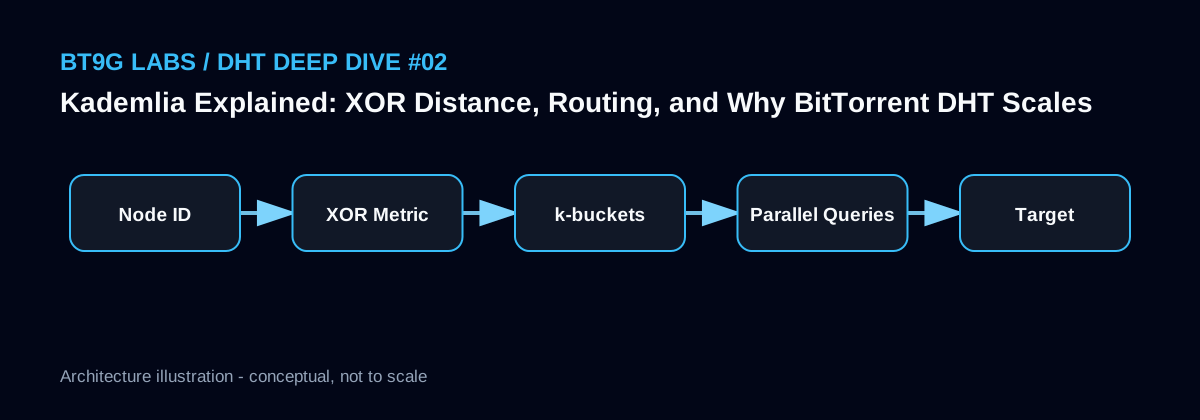
A lookup begins with the best contacts already known locally. The requester sends parallel queries to several candidates and learns about nodes that are closer to the target. Those new candidates enter the frontier, while unresponsive contacts are deprioritized. The process repeats until no newly discovered node is closer than the best set already queried.
The original Kademlia design emphasizes parallel, asynchronous requests. This is important on the public internet because some nodes disappear without warning. Parallelism prevents every dead node from turning into a full timeout penalty on the critical path.
Routing-table locality without geography
A k-bucket does not mean "nearby on the network." It represents an interval in identifier distance. A node keeps more detailed knowledge about regions of the ID space close to itself and coarser knowledge farther away. That asymmetric resolution is sufficient because each hop can hand the lookup to a node with a better view of the remaining distance.
Stable contacts are valuable. Classic Kademlia prefers old responsive nodes over brand-new arrivals because long-lived nodes have a higher chance of remaining online. This creates a routing table that adapts to churn without constantly replacing proven contacts.
Engineering implications for crawlers
A crawler that ignores Kademlia structure and simply sprays random UDP packets wastes bandwidth. Better crawlers maintain their own routing state, prioritize useful contacts, bound concurrent transactions, and avoid repeatedly querying the same dead endpoints.
The highest-throughput system is not necessarily the one with the most goroutines. It is the one that converts network responses into fresh routing knowledge efficiently while keeping socket pressure, timeouts, and duplicate work under control.
Implementation sketch
def xor_distance(a: bytes, b: bytes) -> int:
    return int.from_bytes(a, 'big') ^ int.from_bytes(b, 'big')

contacts.sort(key=lambda n: xor_distance(n.node_id, target))
closest = contacts[:8]
Engineering notes for BT9G Labs
For an indexing system, protocol correctness and data semantics matter more than raw event volume. Keep durable content identity separate from volatile peer observations, retain timestamps on measurements, and make every network-derived field explicit about its source. This prevents the search layer from turning a short-lived observation into a permanent factual claim.
Where possible, record stage-level metrics rather than only total success or failure. That makes it possible to see whether the bottleneck is DHT lookup quality, peer reachability, extension support, metadata transfer, validation, storage, or search indexing.
Common mistakes
- Interpreting XOR distance as physical network latency.
- Replacing stable contacts too aggressively.
- Running lookups serially and paying every timeout in full.
- Using unbounded parallelism that overwhelms the UDP socket.
Related BT9G Labs articles
- What Is DHT? A Practical Guide to BitTorrent's Distributed Hash Table
- How BitTorrent DHT Finds Peers: From Bootstrap to get_peers and announce_peer
- InfoHash Deep Dive: BitTorrent v1, v2, Magnet Links, BTIH, and BTMH
References
← Previous: What Is DHT? A Practical Guide to BitTorrent's Distributed Hash Table Next: How BitTorrent DHT Finds Peers: From Bootstrap to get_peers and announce_peer →
This article explains public BitTorrent protocol behavior for engineering and research purposes. It does not imply that every observed swarm is available, valid, or authorized for redistribution.