
BT9G LABS / DHT Deep Dive #03
How BitTorrent DHT Finds Peers: From Bootstrap to get_peers and announce_peer
Follow a complete BitTorrent DHT peer-discovery flow from an empty routing table to a usable peer list.
BT9G Labs / DHT Deep Dive #03. Follow a complete BitTorrent DHT peer-discovery flow from an empty routing table to a usable peer list.
Quick summary
- Topic: How BitTorrent DHT Finds Peers: From Bootstrap to get_peers and announce_peer
- Core keywords: get_peers, announce_peer, bootstrap DHT, find_node, peer discovery
- Audience: backend engineers, protocol researchers, search engineers, and BitTorrent implementers
- Goal: explain the mechanism accurately enough to support real crawler and indexing architecture decisions
System view
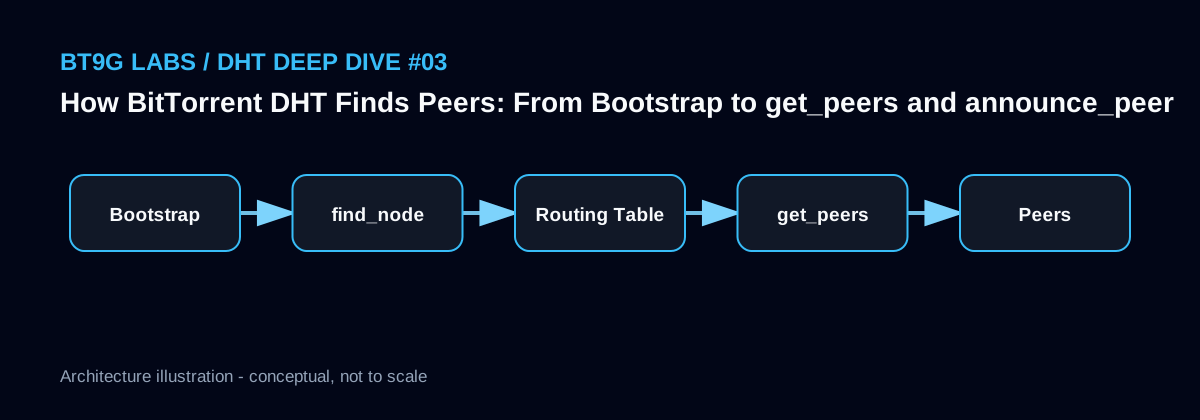
Stage 1: bootstrap
A DHT node cannot route anywhere if it knows nobody. Bootstrap solves that initial knowledge problem. A client starts with one or more known contacts, previously persisted nodes, or addresses learned from peers that advertise DHT support. It pings those contacts and begins populating its routing table with responsive node IDs and UDP endpoints.
Bootstrap is not a privileged protocol mode. It is simply the first round of normal DHT interaction performed from a nearly empty routing table.
Stage 2: build routing knowledge
find_node asks a remote node for contacts close to a target node ID. Repeating this operation across different targets helps a new client populate useful distance ranges in its routing table. Each successful message is also evidence that the sender is alive and can refresh the relevant bucket.
A mature node therefore accumulates routing knowledge as a side effect of ordinary operation. It does not need a complete snapshot of the DHT to participate effectively.
Stage 3: search for a swarm
For peer discovery, the target is the torrent infohash. The client sends get_peers to the closest DHT nodes it currently knows. If a queried node has recently stored peer contacts for that infohash, it can return them in compact form. Otherwise it returns nodes closer to the target so the requester can continue the search.
Every successful get_peers response also contains a token. That token is later used if the requester wants to announce itself as a peer for the same swarm.
Stage 4: announce participation
announce_peer is the write-like operation of BEP 5. It tells a DHT node that a peer endpoint is participating in the swarm. The receiving node validates the token and then stores the peer contact temporarily.
For search engines and crawlers, this distinction matters: receiving an announce_peer is evidence about a swarm at a point in time, not proof that the content is currently downloadable. Production systems should retain timestamps and perform independent liveness or metadata checks before drawing stronger conclusions.
Implementation sketch
bootstrap -> ping -> find_node -> richer routing table
                          |
                          v
infohash -> get_peers -> closer nodes -> get_peers -> peers
                                              |
                                              v
                                         token received
                                              |
                                              v
                                         announce_peer
Engineering notes for BT9G Labs
For an indexing system, protocol correctness and data semantics matter more than raw event volume. Keep durable content identity separate from volatile peer observations, retain timestamps on measurements, and make every network-derived field explicit about its source. This prevents the search layer from turning a short-lived observation into a permanent factual claim.
Where possible, record stage-level metrics rather than only total success or failure. That makes it possible to see whether the bottleneck is DHT lookup quality, peer reachability, extension support, metadata transfer, validation, storage, or search indexing.
Common mistakes
- Starting metadata connections before enough peer candidates are collected.
- Failing to deduplicate nodes returned across iterative queries.
- Ignoring transaction timeouts and stale routing entries.
- Treating announce events as permanent swarm membership.
Related BT9G Labs articles
- What Is DHT? A Practical Guide to BitTorrent's Distributed Hash Table
- Kademlia Explained: XOR Distance, Routing, and Why BitTorrent DHT Scales
- InfoHash Deep Dive: BitTorrent v1, v2, Magnet Links, BTIH, and BTMH
- BEP 5 DHT Messages Explained: ping, find_node, get_peers, and announce_peer
References
← Previous: Kademlia Explained: XOR Distance, Routing, and Why BitTorrent DHT Scales Next: InfoHash Deep Dive: BitTorrent v1, v2, Magnet Links, BTIH, and BTMH →
This article explains public BitTorrent protocol behavior for engineering and research purposes. It does not imply that every observed swarm is available, valid, or authorized for redistribution.