
BT9G LABS / DHT Deep Dive #05
BEP 5 DHT Messages Explained: ping, find_node, get_peers, and announce_peer
A packet-level guide to the core BitTorrent DHT query types defined by BEP 5.
BT9G Labs / DHT Deep Dive #05. A packet-level guide to the core BitTorrent DHT query types defined by BEP 5.
Quick summary
- Topic: BEP 5 DHT Messages Explained: ping, find_node, get_peers, and announce_peer
- Core keywords: BEP 5, KRPC, ping, find_node, get_peers, announce_peer
- Audience: backend engineers, protocol researchers, search engineers, and BitTorrent implementers
- Goal: explain the mechanism accurately enough to support real crawler and indexing architecture decisions
System view
KRPC envelope
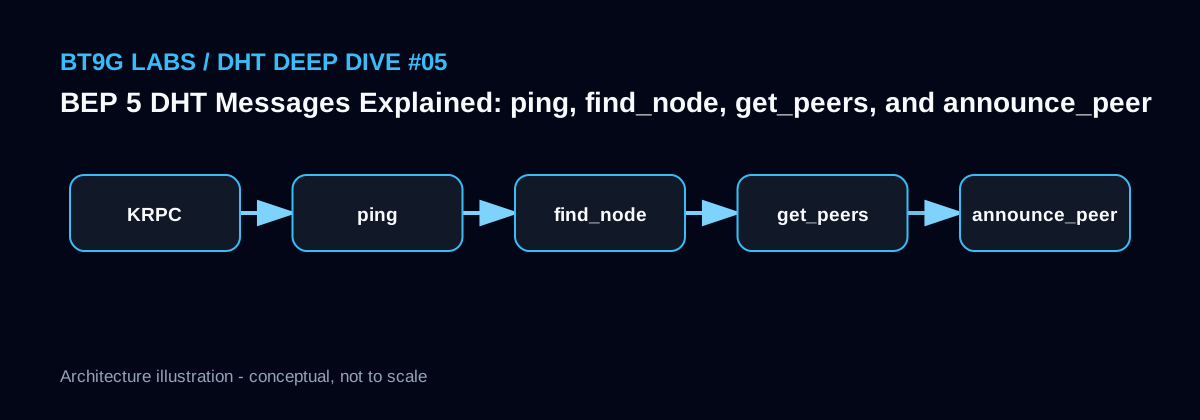
BitTorrent DHT messages are bencoded dictionaries sent over UDP. BEP 5 calls the RPC layer KRPC. A transaction ID lets the requester match a response to an outstanding query, while the message type distinguishes queries, responses, and errors.
This transaction model is small but performance-sensitive. A high-volume crawler may have thousands of in-flight UDP transactions, so transaction IDs, deadlines, endpoint matching, and cleanup behavior need careful engineering.
ping and find_node
ping answers the simplest possible question: is a DHT node responding, and what node ID does it report? It is used for liveness checks and routing-table maintenance.
find_node asks for contacts close to a target ID. It does not search torrent contents. Its purpose is to move a requester through the DHT key space and improve knowledge of nearby nodes.
get_peers
get_peers targets an infohash. A response can contain peer endpoints if the queried node has them, or a compact list of closer DHT nodes if it does not. The response also includes an opaque token that authorizes a subsequent announce_peer operation.
That dual response shape is why parsers must handle both peer values and node lists robustly. A valid lookup often alternates between several rounds of closer-node discovery before yielding peer contacts.
announce_peer
announce_peer is how a peer asks a DHT node to remember its swarm participation. The token returned earlier by get_peers is required. Implementations generally store such contacts for a limited lifetime because public endpoints change frequently.
A crawler should not need to announce arbitrary torrents merely to observe the network. Passive or lookup-oriented designs can collect useful data without polluting the DHT with false peer claims.
Implementation sketch
{
  "t": "aa",
  "y": "q",
  "q": "get_peers",
  "a": {
    "id": "<20-byte node id>",
    "info_hash": "<20-byte infohash>"
  }
}
Engineering notes for BT9G Labs
For an indexing system, protocol correctness and data semantics matter more than raw event volume. Keep durable content identity separate from volatile peer observations, retain timestamps on measurements, and make every network-derived field explicit about its source. This prevents the search layer from turning a short-lived observation into a permanent factual claim.
Where possible, record stage-level metrics rather than only total success or failure. That makes it possible to see whether the bottleneck is DHT lookup quality, peer reachability, extension support, metadata transfer, validation, storage, or search indexing.
Common mistakes
- Reusing transaction IDs too quickly under high concurrency.
- Trusting the reported node ID without sanity checks.
- Assuming get_peers always returns peers.
- Publishing false announce_peer records from a crawler.
Related BT9G Labs articles
- How BitTorrent DHT Finds Peers: From Bootstrap to get_peers and announce_peer
- InfoHash Deep Dive: BitTorrent v1, v2, Magnet Links, BTIH, and BTMH
- Inside a DHT Routing Table: k-Buckets, Node Churn, and Contact Selection
- Why Does the DHT See So Many InfoHashes? Understanding Swarm Discovery at Internet Scale
References
← Previous: InfoHash Deep Dive: BitTorrent v1, v2, Magnet Links, BTIH, and BTMH Next: Inside a DHT Routing Table: k-Buckets, Node Churn, and Contact Selection →
This article explains public BitTorrent protocol behavior for engineering and research purposes. It does not imply that every observed swarm is available, valid, or authorized for redistribution.