
BT9G LABS / DHT Deep Dive #01
What Is DHT? A Practical Guide to BitTorrent's Distributed Hash Table
Learn how BitTorrent DHT replaces a central tracker with a distributed peer-discovery layer built on Kademlia-style routing.
BT9G Labs / DHT Deep Dive #01. Learn how BitTorrent DHT replaces a central tracker with a distributed peer-discovery layer built on Kademlia-style routing.
Quick summary
- Topic: What Is DHT? A Practical Guide to BitTorrent's Distributed Hash Table
- Core keywords: DHT, BitTorrent DHT, distributed hash table, peer discovery, Kademlia
- Audience: backend engineers, protocol researchers, search engineers, and BitTorrent implementers
- Goal: explain the mechanism accurately enough to support real crawler and indexing architecture decisions
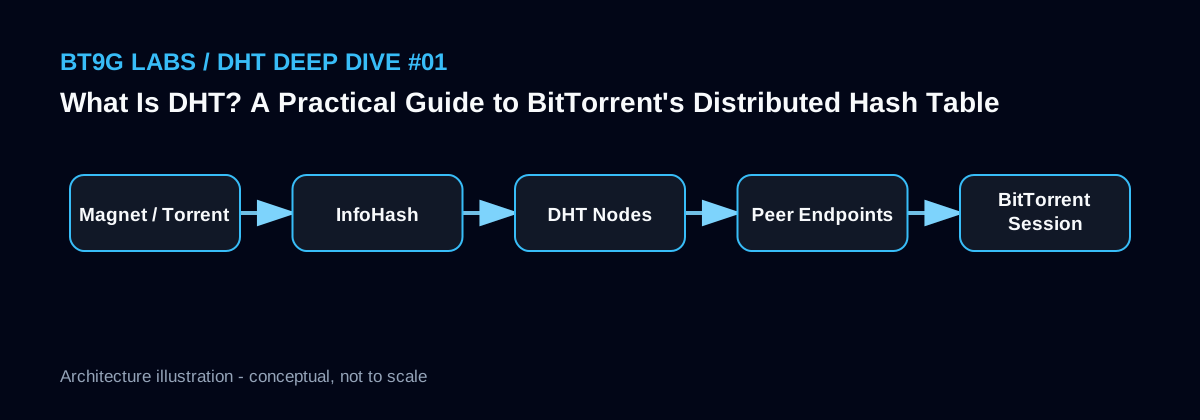
System view
The problem DHT solves
A BitTorrent client needs more than a content identifier. It also needs a way to discover other peers participating in the same swarm. Traditional trackers solve this by keeping a server-side mapping from an infohash to a set of peer endpoints. That design is simple, but the tracker becomes infrastructure that must stay online and reachable.
BitTorrent DHT moves the peer-location function into a decentralized overlay. Instead of asking one tracker, a client asks a sequence of DHT nodes which nodes are closer to the target infohash. As the lookup converges, the client reaches nodes that either know peers for that infohash or know still-closer DHT nodes. In BEP 5 terminology, a node speaks the DHT protocol over UDP, while a peer speaks the BitTorrent peer protocol and transfers torrent data.
A useful mental model
Think of the DHT as a very large, constantly changing address directory. The key is the torrent's 20-byte v1 infohash. The value is not the file itself; the useful value is a collection of peer contact points that claim participation in the swarm. The DHT therefore helps answer: "Who might have this content?" It does not answer: "What files are inside this torrent?" Metadata exchange handles that later.
Every participating DHT node has a node ID in the same logical key space. Kademlia-style XOR distance gives each node a deterministic way to decide which contacts are closer to a target. Because each node only stores a bounded routing table rather than the whole network, the system can scale while remaining decentralized.
From cold start to peers
A fresh client first bootstraps from known DHT nodes or contacts learned from previous sessions. It then issues find_node queries to improve its routing table. When the client wants peers for an infohash, it performs iterative get_peers queries toward nodes that are progressively closer to that hash. A response may contain compact peer endpoints or another set of closer nodes.
If the client later wants to advertise its own participation, it sends announce_peer using a token previously returned by get_peers. That token is important because it makes blind write amplification harder: the announcing client must demonstrate that it recently contacted the target node from the relevant network address.
What DHT does not guarantee
DHT is a discovery mechanism, not a global database with durable records. Nodes churn, NAT changes endpoints, torrents die, malicious actors inject junk, and a lookup can fail even when peers exist. A production crawler therefore treats DHT observations as probabilistic signals with timestamps rather than permanent truth.
This distinction is central for search infrastructure such as BT9G Labs. An infohash seen once can be retained for later retry, while peer endpoints should be considered short-lived. The right architecture separates durable content identity from volatile network observations.
Implementation sketch
// Conceptual lookup loop. Production code needs transaction IDs,
// compact-node parsing, timeouts, retries, and routing-table maintenance.
for frontier.NotEmpty() {
    node := frontier.PopClosest(targetInfoHash)
    resp, err := dht.GetPeers(node, targetInfoHash)
    if err != nil { continue }
    peers.Add(resp.Peers...)
    frontier.Add(resp.CloserNodes...)
}
Engineering notes for BT9G Labs
For an indexing system, protocol correctness and data semantics matter more than raw event volume. Keep durable content identity separate from volatile peer observations, retain timestamps on measurements, and make every network-derived field explicit about its source. This prevents the search layer from turning a short-lived observation into a permanent factual claim.
Where possible, record stage-level metrics rather than only total success or failure. That makes it possible to see whether the bottleneck is DHT lookup quality, peer reachability, extension support, metadata transfer, validation, storage, or search indexing.
Common mistakes
- Confusing DHT nodes with BitTorrent peers.
- Treating a peer endpoint as durable data.
- Assuming a single failed lookup means a torrent is dead.
- Expecting DHT to provide filenames or file sizes directly.
Related BT9G Labs articles
- Kademlia Explained: XOR Distance, Routing, and Why BitTorrent DHT Scales
- How BitTorrent DHT Finds Peers: From Bootstrap to get_peers and announce_peer
References
Next: Kademlia Explained: XOR Distance, Routing, and Why BitTorrent DHT Scales →
This article explains public BitTorrent protocol behavior for engineering and research purposes. It does not imply that every observed swarm is available, valid, or authorized for redistribution.