
BT9G LABS / DHT Deep Dive #08
How DHT Crawlers Discover InfoHashes: Active Lookups, Observations, and Responsible Design
A systems-level guide to discovering infohashes from public DHT activity without confusing discovery with metadata acquisition.
BT9G Labs / DHT Deep Dive #08. A systems-level guide to discovering infohashes from public DHT activity without confusing discovery with metadata acquisition.
Quick summary
- Topic: How DHT Crawlers Discover InfoHashes: Active Lookups, Observations, and Responsible Design
- Core keywords: DHT crawler, infohash crawler, BitTorrent crawler, DHT monitoring, torrent discovery
- Audience: backend engineers, protocol researchers, search engineers, and BitTorrent implementers
- Goal: explain the mechanism accurately enough to support real crawler and indexing architecture decisions
System view
Discovery and acquisition are separate pipelines
A scalable crawler separates learning that an infohash exists from fetching the torrent metadata. Discovery is UDP-heavy and cheap per event. Metadata retrieval usually requires TCP or uTP peer sessions, protocol handshakes, extension negotiation, multiple pieces, validation, and more state.
Decoupling the two lets the discovery edge remain fast even when metadata workers are saturated.
Active and observational strategies
An active crawler participates as a normal DHT node, maintains routing state, and performs legitimate lookups to learn about the overlay. An observational component records infohashes encountered in queries or responses that reach the node. The exact yield depends on node-ID placement, uptime, routing quality, and network conditions.
A robust design does not assume one node can see the whole DHT. Multiple long-running nodes provide a broader sample, but their data still represents observations rather than a complete census.
The ingestion hot path
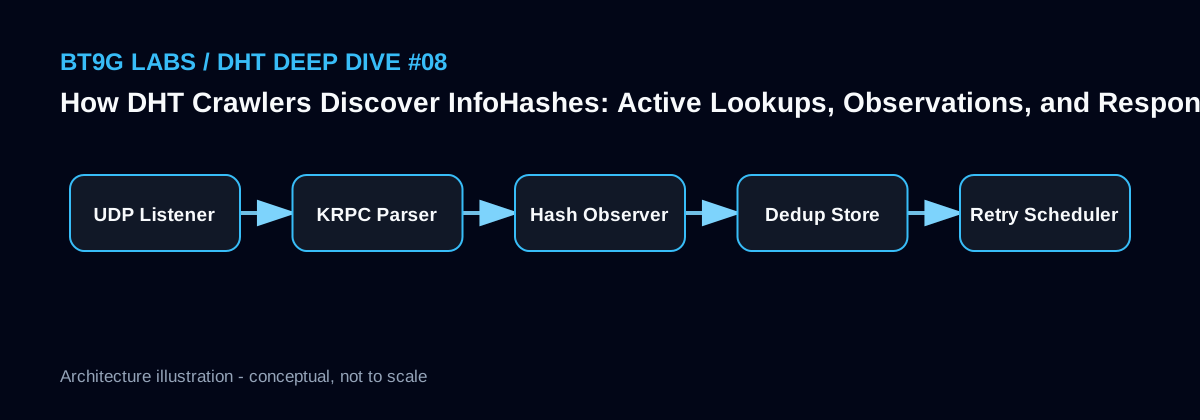
The packet path should do as little blocking work as possible: validate message shape, extract relevant identifiers, normalize endpoints, update routing state, and emit compact events to a queue. Database writes, metadata sessions, enrichment, and search indexing belong downstream.
Backpressure is essential. If the event queue is full, a crawler must have a defined degradation strategy rather than allowing memory to grow without limit.
Responsible network behavior
Public DHT participation should avoid unnecessary amplification, false announcements, and abusive retry rates. Rate limits per endpoint, sane transaction deadlines, packet validation, and bounded concurrency protect both the crawler and the network.
This is also good engineering: abusive traffic produces worse data because remote nodes rate-limit, disappear, or blacklist the source.
Implementation sketch
func handlePacket(pkt []byte, from *net.UDPAddr) {
    msg, err := krpc.Parse(pkt)
    if err != nil { return }
    routing.Observe(msg.NodeID, from)
    if ih, ok := msg.InfoHash(); ok {
        observer.TryEmit(HashEvent{Hash: ih, SeenAt: time.Now()})
    }
}
Engineering notes for BT9G Labs
For an indexing system, protocol correctness and data semantics matter more than raw event volume. Keep durable content identity separate from volatile peer observations, retain timestamps on measurements, and make every network-derived field explicit about its source. This prevents the search layer from turning a short-lived observation into a permanent factual claim.
Where possible, record stage-level metrics rather than only total success or failure. That makes it possible to see whether the bottleneck is DHT lookup quality, peer reachability, extension support, metadata transfer, validation, storage, or search indexing.
Common mistakes
- Doing synchronous SQL writes in the UDP receive loop.
- Assuming one crawler node observes the complete network.
- Sending false announce_peer messages to increase visibility.
- Allowing unbounded queues during traffic bursts.
Related BT9G Labs articles
- Inside a DHT Routing Table: k-Buckets, Node Churn, and Contact Selection
- Why Does the DHT See So Many InfoHashes? Understanding Swarm Discovery at Internet Scale
- How a Magnet Link Becomes File Metadata: The Complete Peer and Metadata Flow
- BEP 9 ut_metadata Explained: Fetching Torrent Metadata from Peers
References
← Previous: Why Does the DHT See So Many InfoHashes? Understanding Swarm Discovery at Internet Scale Next: How a Magnet Link Becomes File Metadata: The Complete Peer and Metadata Flow →
This article explains public BitTorrent protocol behavior for engineering and research purposes. It does not imply that every observed swarm is available, valid, or authorized for redistribution.