
BT9G LABS / DHT Deep Dive #10
BEP 9 ut_metadata Explained: Fetching Torrent Metadata from Peers
A technical guide to BEP 9 message types, metadata pieces, validation, and crawler implementation details.
BT9G Labs / DHT Deep Dive #10. A technical guide to BEP 9 message types, metadata pieces, validation, and crawler implementation details.
Quick summary
- Topic: BEP 9 ut_metadata Explained: Fetching Torrent Metadata from Peers
- Core keywords: BEP 9, ut_metadata, metadata_size, torrent metadata, magnet metadata
- Audience: backend engineers, protocol researchers, search engineers, and BitTorrent implementers
- Goal: explain the mechanism accurately enough to support real crawler and indexing architecture decisions
System view
What BEP 9 transfers
BEP 9 exists so a client can join a swarm without first downloading a .torrent file from the web. The extension transfers the bencoded info dictionary. That exact byte sequence is enough to verify the expected infohash and recover the core torrent metadata.
It deliberately does not mean that every outer field of a historical .torrent file is reconstructed. Indexers should understand which information belongs inside the info dictionary and which optional fields may be absent.
Message lifecycle
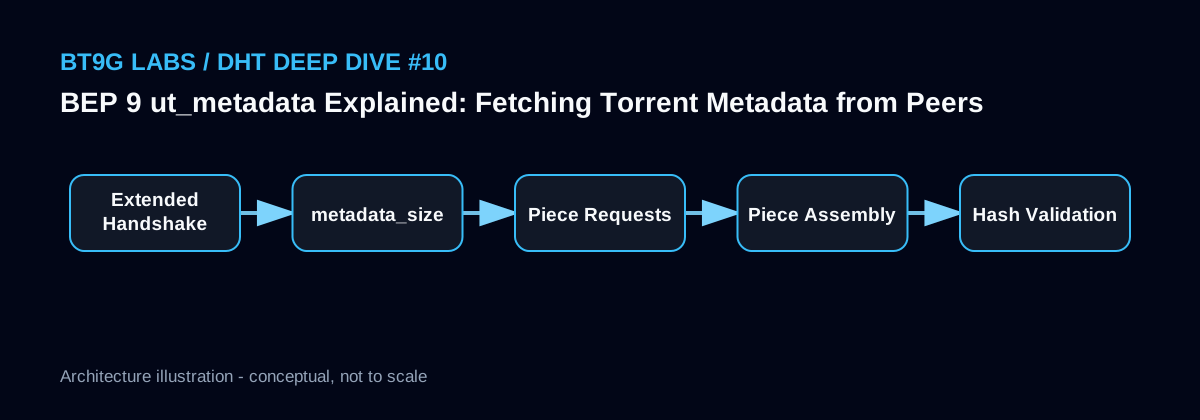
After the BEP 10 extended handshake identifies the negotiated message ID for ut_metadata, the requester sends metadata request messages by piece index. The responder may return data or reject a request. Large metadata is divided into multiple pieces and reassembled by the requester.
A crawler should limit the number of in-flight metadata requests per peer. Flooding requests can trigger disconnects and wastes bandwidth when the peer is slow or dishonest.
Validation is non-negotiable
When all metadata pieces arrive, the crawler must reconstruct the exact info dictionary bytes and calculate the expected hash. For v1, that check is SHA-1 over the bencoded info dictionary. A mismatch means the metadata is unusable for that requested swarm.
Additional structural validation is also useful: reject absurd lengths, maliciously deep bencoding, duplicate path entries, or metadata that exceeds configured limits.
Scheduling across multiple peers
Metadata retrieval succeeds more often when the scheduler treats peers as a pool. If one endpoint times out, another peer for the same infohash can continue the attempt. Systems can score endpoints by recent success rate, RTT, client behavior, and network family.
The scheduler should retain an infohash independently of any one peer endpoint. Peers are ephemeral; the content identifier is durable.
Implementation sketch
{"msg_type": 0, "piece": 0}          // request
{"msg_type": 1, "piece": 0,
 "total_size": 48321}                // data header, followed by bytes
{"msg_type": 2, "piece": 0}          // reject
Engineering notes for BT9G Labs
For an indexing system, protocol correctness and data semantics matter more than raw event volume. Keep durable content identity separate from volatile peer observations, retain timestamps on measurements, and make every network-derived field explicit about its source. This prevents the search layer from turning a short-lived observation into a permanent factual claim.
Where possible, record stage-level metrics rather than only total success or failure. That makes it possible to see whether the bottleneck is DHT lookup quality, peer reachability, extension support, metadata transfer, validation, storage, or search indexing.
Common mistakes
- Treating BEP 9 pieces as payload file pieces.
- Skipping hash verification after assembly.
- Allowing unlimited metadata size.
- Binding retry state permanently to one peer endpoint.
Related BT9G Labs articles
- How DHT Crawlers Discover InfoHashes: Active Lookups, Observations, and Responsible Design
- How a Magnet Link Becomes File Metadata: The Complete Peer and Metadata Flow
- BEP 10 Extension Protocol: How BitTorrent Negotiates Features Without Breaking Compatibility
- Tracker vs DHT vs PEX: Three BitTorrent Peer-Discovery Mechanisms Compared
References
← Previous: How a Magnet Link Becomes File Metadata: The Complete Peer and Metadata Flow Next: BEP 10 Extension Protocol: How BitTorrent Negotiates Features Without Breaking Compatibility →
This article explains public BitTorrent protocol behavior for engineering and research purposes. It does not imply that every observed swarm is available, valid, or authorized for redistribution.