
BT9G LABS / DHT Deep Dive #12
Tracker vs DHT vs PEX: Three BitTorrent Peer-Discovery Mechanisms Compared
Compare centralized trackers, decentralized DHT lookups, and peer exchange as complementary ways to discover swarm participants.
BT9G Labs / DHT Deep Dive #12. Compare centralized trackers, decentralized DHT lookups, and peer exchange as complementary ways to discover swarm participants.
Quick summary
- Topic: Tracker vs DHT vs PEX: Three BitTorrent Peer-Discovery Mechanisms Compared
- Core keywords: tracker vs DHT, PEX, peer exchange, peer discovery, BitTorrent tracker
- Audience: backend engineers, protocol researchers, search engineers, and BitTorrent implementers
- Goal: explain the mechanism accurately enough to support real crawler and indexing architecture decisions
System view
They solve the same immediate problem differently
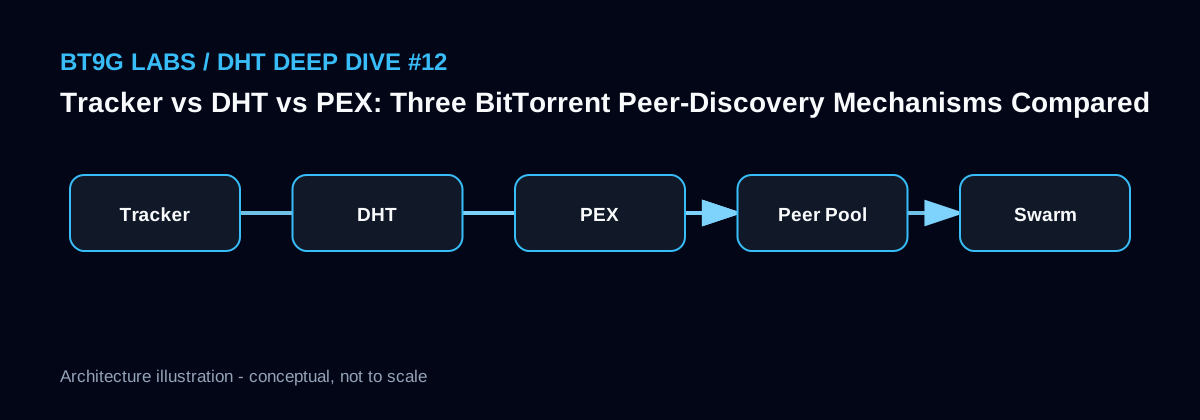
Trackers, DHT, and PEX all help a client discover peer endpoints, but their trust and topology models differ. A tracker is a service endpoint queried by the client. DHT is a decentralized overlay that routes toward an infohash. PEX is peer-to-peer gossip among already connected swarm participants.
A robust BitTorrent client commonly uses more than one mechanism because they fail in different ways.
Trackers: direct and measurable
A tracker can return peers quickly and can expose aggregate scrape counters such as complete and incomplete participants when supported. The trade-off is operational dependence on the tracker's reachability, policy, and rate limits.
From an indexer's perspective, trackers can provide strong point-in-time signals, but not every magnet has a useful tracker and not every tracker supports scrape.
DHT: decentralized bootstrap and reach
DHT removes the requirement for a specific central server. It can discover peers for trackerless torrents and continue working when tracker infrastructure disappears. The cost is probabilistic routing, network churn, and less direct aggregate statistics.
DHT is especially valuable to crawlers as a discovery surface for infohashes and peer candidates.
PEX: freshness after connection
PEX becomes useful after a client already has peer connections. BEP 11 explicitly positions it as an alternative peer-discovery mechanism once a swarm has been bootstrapped by mechanisms such as DHT or tracker announces. Because peers share current connections, PEX can provide a fresh local view of the swarm.
PEX is therefore not a universal cold-start solution. It amplifies an existing foothold rather than replacing every other discovery method.
Implementation sketch
Cold start:
  Tracker -----------                       +--> Peer Pool --> Swarm
  DHT ---------------/

After connections exist:
  Connected Peer --PEX--> More Peer Candidates
Engineering notes for BT9G Labs
For an indexing system, protocol correctness and data semantics matter more than raw event volume. Keep durable content identity separate from volatile peer observations, retain timestamps on measurements, and make every network-derived field explicit about its source. This prevents the search layer from turning a short-lived observation into a permanent factual claim.
Where possible, record stage-level metrics rather than only total success or failure. That makes it possible to see whether the bottleneck is DHT lookup quality, peer reachability, extension support, metadata transfer, validation, storage, or search indexing.
Common mistakes
- Treating PEX as a cold-start mechanism.
- Assuming tracker scrape is universally supported.
- Calling DHT peer counts exact global swarm counts.
- Using only one discovery mechanism when resilience matters.
Related BT9G Labs articles
- BEP 9 ut_metadata Explained: Fetching Torrent Metadata from Peers
- BEP 10 Extension Protocol: How BitTorrent Negotiates Features Without Breaking Compatibility
- Seeders and Leechers: What the Numbers Mean and How They Are Measured
- Why Torrent Metadata Retrieval Fails: 10 Real Causes and a Better Retry Model
References
← Previous: BEP 10 Extension Protocol: How BitTorrent Negotiates Features Without Breaking Compatibility Next: Seeders and Leechers: What the Numbers Mean and How They Are Measured →
This article explains public BitTorrent protocol behavior for engineering and research purposes. It does not imply that every observed swarm is available, valid, or authorized for redistribution.