
BT9G LABS / DHT Deep Dive #20
How BT9G Can Index BitTorrent Metadata at Scale: A Reference DHT Architecture
A reference architecture for BT9G Labs that connects DHT discovery, durable infohash state, metadata acquisition, search indexing, and observability.
BT9G Labs / DHT Deep Dive #20. A reference architecture for BT9G Labs that connects DHT discovery, durable infohash state, metadata acquisition, search indexing, and observability.
Quick summary
- Topic: How BT9G Can Index BitTorrent Metadata at Scale: A Reference DHT Architecture
- Core keywords: BT9G, DHT architecture, torrent indexing, metadata crawler, BitTorrent search engine
- Audience: backend engineers, protocol researchers, search engineers, and BitTorrent implementers
- Goal: explain the mechanism accurately enough to support real crawler and indexing architecture decisions
System view
Layer 1: discovery edge
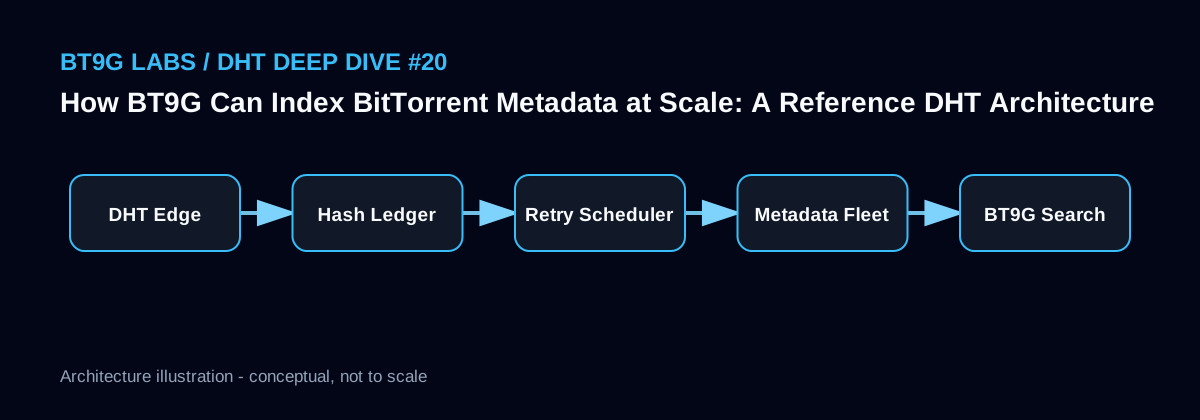
The DHT edge is a set of long-running nodes with healthy routing tables. Their job is to participate in the public DHT, observe infohash activity, and emit normalized events. They should remain lightweight enough that database stalls or search reindexing cannot interrupt UDP processing.
Each event carries the content identifier, observation time, event source, and limited network context. Raw packet retention should be avoided unless there is a specific debugging or research need.
Layer 2: the hash ledger
The hash ledger is the durable memory of the system. It deduplicates observations and tracks first seen, last seen, counts, metadata state, failure class, next retry, and version information. This layer allows BT9G to accumulate long-term discovery value even when metadata is temporarily unavailable.
A hot cache or Bloom filter can reduce database load, but the exact durable ledger remains authoritative.
Layer 3: metadata acquisition fleet
Metadata workers claim due hashes, gather peer candidates, open BitTorrent sessions, negotiate BEP 10, request BEP 9 metadata, validate the resulting infohash, and persist successful results. Endpoint reputation and stage-level metrics improve throughput over time.
Workers can scale horizontally and can be placed in more than one network region to reduce dependence on a single routing environment.
Layer 4: serving and ranking
Validated metadata is transformed into search documents for BT9G. Search fields can include normalized title, file tree, size, extension groups, age, language hints, and source-specific activity measurements. Internal links from Labs articles can point to protocol explainers rather than to individual indexed torrents, strengthening the site's technical knowledge graph.
The user-facing product should keep measurement semantics explicit: last seen is not creation time, observed peers are not exact global peers, and tracker counts are tracker-specific.
Layer 5: observability and feedback
The feedback loop measures unique hashes per minute, dedup ratio, lookup success, peers per hash, connection success, BEP 10 support, BEP 9 success, validation failures, queue age, and index freshness. These metrics tell the team where the real bottleneck is.
BT9G Labs can publish protocol-level explanations of these components without exposing operational secrets. That creates useful technical content while reinforcing the site's expertise around DHT, metadata, and decentralized indexing.
Implementation sketch
DHT observers
    |
    v
Hash event bus ---> metrics
    |
    v
Exact hash ledger <---- fresh activity wakes cold hashes
    |
    v
Retry / priority scheduler
    |
    v
Metadata fleet -> hash validation -> canonical metadata DB
                                   |
                                   v
                              enrichment
                                   |
                                   v
                              search index
                                   |
                                   v
                                BT9G
Engineering notes for BT9G Labs
For an indexing system, protocol correctness and data semantics matter more than raw event volume. Keep durable content identity separate from volatile peer observations, retain timestamps on measurements, and make every network-derived field explicit about its source. This prevents the search layer from turning a short-lived observation into a permanent factual claim.
Where possible, record stage-level metrics rather than only total success or failure. That makes it possible to see whether the bottleneck is DHT lookup quality, peer reachability, extension support, metadata transfer, validation, storage, or search indexing.
Common mistakes
- Coupling DHT packet handling to search indexing.
- Deleting cold hashes instead of backing them off.
- Indexing before cryptographic validation.
- Exposing internal scores as if they were exact network-wide statistics.
Related BT9G Labs articles
- Why Failed InfoHashes Should Stay: Designing a Long-Term Retry Scheduler
- Building a BitTorrent Search Index: DHT to Metadata to Elasticsearch
References
- BEP 5 - DHT Protocol
- BEP 9 - Extension for Peers to Send Metadata Files
- BEP 10 - Extension Protocol
- BEP 11 - Peer Exchange (PEX)
- BEP 48 - Tracker Protocol Extension: Scrape
- BEP 52 - The BitTorrent Protocol Specification v2
- Kademlia: A Peer-to-peer Information System Based on the XOR Metric
← Previous: Building a BitTorrent Search Index: DHT to Metadata to Elasticsearch
This article explains public BitTorrent protocol behavior for engineering and research purposes. It does not imply that every observed swarm is available, valid, or authorized for redistribution.