
BT9G LABS / DHT Deep Dive #15
Designing a High-Performance DHT Crawler: Architecture, Queues, and Backpressure
A practical architecture for high-throughput DHT observation with bounded memory, efficient UDP handling, and decoupled metadata workers.
BT9G Labs / DHT Deep Dive #15. A practical architecture for high-throughput DHT observation with bounded memory, efficient UDP handling, and decoupled metadata workers.
Quick summary
- Topic: Designing a High-Performance DHT Crawler: Architecture, Queues, and Backpressure
- Core keywords: high performance DHT crawler, DHT architecture, UDP crawler, BitTorrent crawler, backpressure
- Audience: backend engineers, protocol researchers, search engineers, and BitTorrent implementers
- Goal: explain the mechanism accurately enough to support real crawler and indexing architecture decisions
System view
Separate the packet plane from the work plane
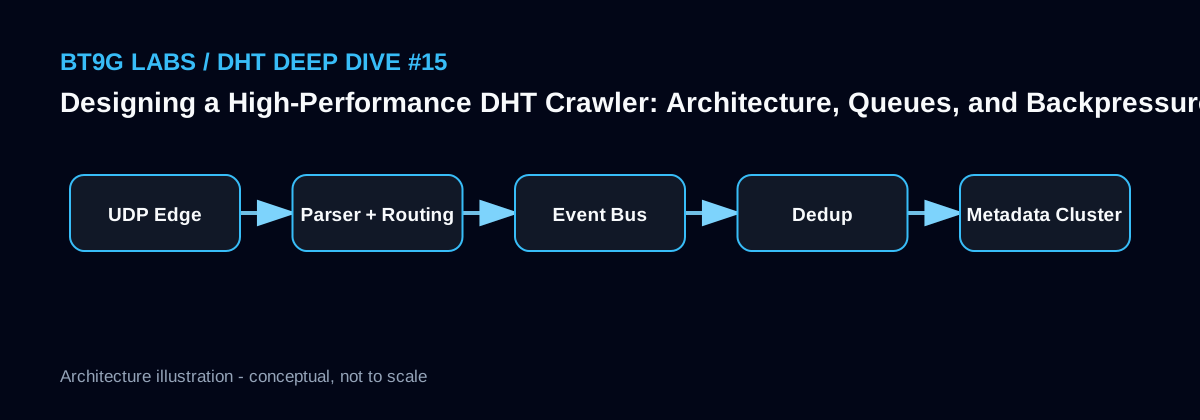
The UDP edge should remain small and predictable. Its job is to receive packets, validate KRPC, update routing state, and emit compact events. Expensive operations such as SQL writes, metadata downloads, text normalization, and search indexing belong to independent workers.
This separation prevents a slow database or a burst of metadata sessions from causing packet loss at the socket layer.
Bound everything
Every queue, goroutine pool, transaction map, peer pool, and retry list needs a limit. Unbounded concurrency performs well in a short benchmark and fails spectacularly under a traffic spike. Bounded systems make overload visible and controllable.
Key metrics include UDP receive drops, KRPC parse errors, in-flight transactions, queue depth, dedup hit ratio, metadata success rate, open sockets, and per-stage latency percentiles.
Shard by responsibility, not just by CPU
Horizontal scaling can separate DHT observers from metadata collectors. Observers are UDP-heavy and benefit from long-lived routing state. Metadata workers are connection-heavy and may need different egress, timeout, and file-validation policies.
A message bus or durable queue connects the two, making it possible to add metadata capacity without resetting DHT routing knowledge.
Optimize after measuring
The largest gains often come from reducing duplicate work, shortening hopeless timeouts, and reusing validated peer knowledge rather than micro-optimizing bencode parsing. Profiling should distinguish CPU saturation from network wait, kernel socket limits, queue contention, and database latency.
At scale, system efficiency is the ratio of useful unique metadata recovered to network and compute cost, not raw packets per second.
Implementation sketch
[UDP sockets]
     |
     v
[KRPC + routing] ---> metrics
     |
     v
[bounded hash-event queue]
     |
     v
[dedup / scheduler] ---> [retry store]
     |
     v
[metadata workers] ---> [validation] ---> [DB / Search]
Engineering notes for BT9G Labs
For an indexing system, protocol correctness and data semantics matter more than raw event volume. Keep durable content identity separate from volatile peer observations, retain timestamps on measurements, and make every network-derived field explicit about its source. This prevents the search layer from turning a short-lived observation into a permanent factual claim.
Where possible, record stage-level metrics rather than only total success or failure. That makes it possible to see whether the bottleneck is DHT lookup quality, peer reachability, extension support, metadata transfer, validation, storage, or search indexing.
Common mistakes
- Writing to the database on the receive goroutine.
- Using unbounded worker creation.
- Scaling metadata workers and DHT observers as one inseparable process.
- Optimizing packet parsing before measuring duplicate work.
Related BT9G Labs articles
- Seeders and Leechers: What the Numbers Mean and How They Are Measured
- Why Torrent Metadata Retrieval Fails: 10 Real Causes and a Better Retry Model
- What It Takes to Fetch 1,000+ Torrent Metadata Records per Minute
- How to Deduplicate Billions of InfoHash Observations Without Wasting Metadata Work
References
- BEP 5 - DHT Protocol
- BEP 9 - Extension for Peers to Send Metadata Files
- Kademlia: A Peer-to-peer Information System Based on the XOR Metric
← Previous: Why Torrent Metadata Retrieval Fails: 10 Real Causes and a Better Retry Model Next: What It Takes to Fetch 1,000+ Torrent Metadata Records per Minute →
This article explains public BitTorrent protocol behavior for engineering and research purposes. It does not imply that every observed swarm is available, valid, or authorized for redistribution.