
BT9G LABS / DHT Deep Dive #19
Building a BitTorrent Search Index: DHT to Metadata to Elasticsearch
An end-to-end architecture for turning decentralized BitTorrent observations into validated, searchable metadata documents.
BT9G Labs / DHT Deep Dive #19. An end-to-end architecture for turning decentralized BitTorrent observations into validated, searchable metadata documents.
Quick summary
- Topic: Building a BitTorrent Search Index: DHT to Metadata to Elasticsearch
- Core keywords: BitTorrent search engine architecture, DHT Elasticsearch, torrent index, metadata pipeline, search indexing
- Audience: backend engineers, protocol researchers, search engineers, and BitTorrent implementers
- Goal: explain the mechanism accurately enough to support real crawler and indexing architecture decisions
System view
The search index should be downstream of validation
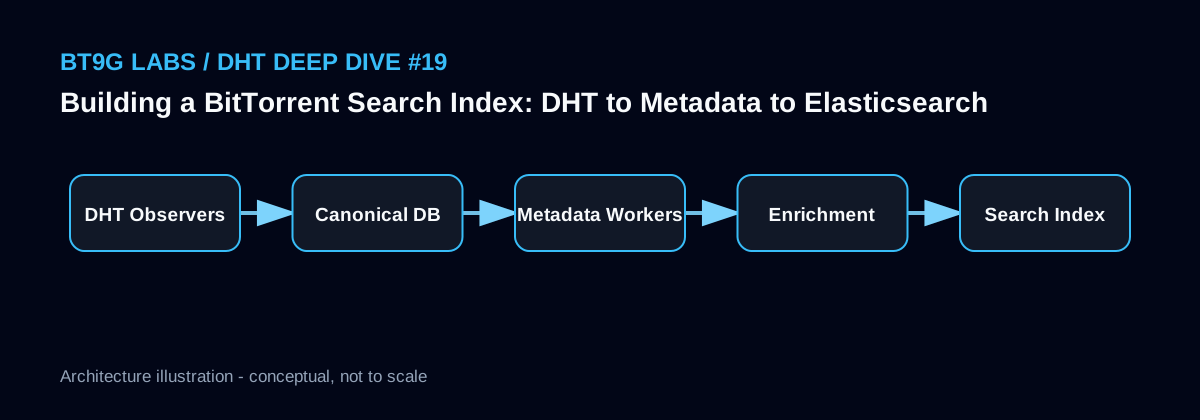
The public search layer should never consume raw DHT packets directly. A safer pipeline first extracts and deduplicates infohashes, retrieves metadata, verifies the content identifier, parses the file tree, and normalizes searchable fields. Only validated records become search documents.
This keeps untrusted network input away from the user-facing index and makes reindexing possible without recrawling the DHT.
Canonical storage and derived search storage
A relational or other durable canonical store holds content identity, validated metadata, acquisition state, and observation history. Elasticsearch or another search engine holds denormalized documents optimized for full-text queries, filters, sorting, language analyzers, and ranking.
If the search index is lost, it should be rebuildable from canonical data. That principle simplifies disaster recovery and schema migrations.
Enrichment without corrupting identity
Search products often derive display title, extension groups, total size, file count, media hints, language hints, and popularity features. These fields should be versioned or reproducible because they are interpretations layered on top of the immutable torrent metadata.
The raw validated info dictionary can be retained in compressed form for forensic reprocessing when parsers improve.
Ranking signals
Useful ranking features include metadata recency, last network activity, successful recent peer connections, tracker-reported counts, DHT observation frequency, title quality, file-tree coherence, and abuse flags. None of these alone is a perfect popularity measure.
Search ranking works best when source-specific measurements remain separate in storage and are combined by a transparent scoring layer.
Implementation sketch
{
  "infohash": "...",
  "title": "Example Release",
  "total_size": 734003200,
  "file_count": 12,
  "extensions": ["mkv", "srt"],
  "first_seen": "...",
  "last_seen": "...",
  "metadata_verified": true,
  "activity_score": 0.73
}
Engineering notes for BT9G Labs
For an indexing system, protocol correctness and data semantics matter more than raw event volume. Keep durable content identity separate from volatile peer observations, retain timestamps on measurements, and make every network-derived field explicit about its source. This prevents the search layer from turning a short-lived observation into a permanent factual claim.
Where possible, record stage-level metrics rather than only total success or failure. That makes it possible to see whether the bottleneck is DHT lookup quality, peer reachability, extension support, metadata transfer, validation, storage, or search indexing.
Common mistakes
- Indexing unverified metadata.
- Making Elasticsearch the only copy of canonical data.
- Overwriting raw metadata with guessed labels.
- Calling one noisy activity signal "popularity."
Related BT9G Labs articles
- How to Deduplicate Billions of InfoHash Observations Without Wasting Metadata Work
- Why Failed InfoHashes Should Stay: Designing a Long-Term Retry Scheduler
- How BT9G Can Index BitTorrent Metadata at Scale: A Reference DHT Architecture
References
- BEP 5 - DHT Protocol
- BEP 9 - Extension for Peers to Send Metadata Files
- BEP 10 - Extension Protocol
- BEP 48 - Tracker Protocol Extension: Scrape
← Previous: Why Failed InfoHashes Should Stay: Designing a Long-Term Retry Scheduler Next: How BT9G Can Index BitTorrent Metadata at Scale: A Reference DHT Architecture →
This article explains public BitTorrent protocol behavior for engineering and research purposes. It does not imply that every observed swarm is available, valid, or authorized for redistribution.