
BT9G LABS / DHT Deep Dive #16
What It Takes to Fetch 1,000+ Torrent Metadata Records per Minute
Capacity-plan a metadata pipeline around peer discovery, connection success rates, timeout budgets, and scheduler concurrency.
BT9G Labs / DHT Deep Dive #16. Capacity-plan a metadata pipeline around peer discovery, connection success rates, timeout budgets, and scheduler concurrency.
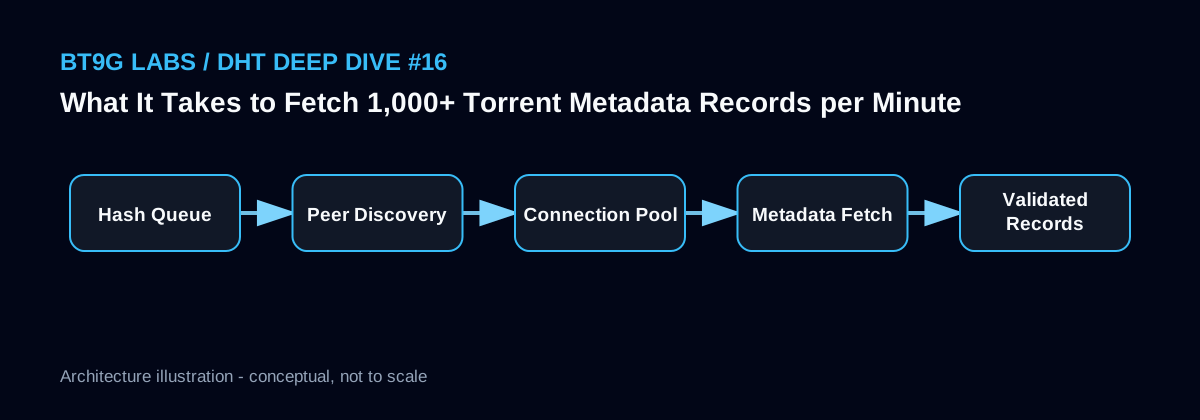
Quick summary
- Topic: What It Takes to Fetch 1,000+ Torrent Metadata Records per Minute
- Core keywords: 1000 metadata per minute, torrent metadata crawler, BitTorrent performance, crawler capacity, metadata throughput
- Audience: backend engineers, protocol researchers, search engineers, and BitTorrent implementers
- Goal: explain the mechanism accurately enough to support real crawler and indexing architecture decisions
System view
Start from success throughput, not request throughput
One thousand validated metadata records per minute means about 16.7 successful completions per second. The crawler will need substantially more connection attempts because many candidate peers are stale, unreachable, unsupported, or slow.
Capacity planning therefore starts with measured conversion rates: hashes with peers, peer connection success, extension support, metadata completion, and final hash validation.
Little's Law gives a useful first estimate
If the average successful-or-failed metadata session occupies a slot for four seconds and the system must complete roughly 17 successes per second, then even a perfect 100% success rate would require around 68 concurrent sessions. At a 25% end-to-end success rate, the practical concurrency requirement becomes much larger.
The correct number must come from production latency and success histograms, not from a fixed folklore value such as "500 goroutines."
The peer-discovery stage can be the hidden bottleneck
Metadata workers are useless if they receive hashes with no viable peers. A high-throughput design therefore keeps peer discovery ahead of metadata demand and can attach multiple candidate endpoints to each scheduled hash.
Short, well-classified timeouts are valuable. Spending 30 seconds on obviously dead peers destroys throughput far faster than small CPU inefficiencies.
Host limits matter
File-descriptor limits, ephemeral ports, conntrack, NAT capacity, kernel buffers, and egress bandwidth can all cap throughput before CPU or RAM. Monitoring needs to cover operating-system resource pressure as well as application metrics.
For distributed deployments, spreading metadata connections across several modest workers often gives more predictable results than one extremely large process with a huge failure domain.
Implementation sketch
Target: 1000 validated metadata / minute
      = 16.7 successes / second

Required attempt rate ~= success_rate_target / end_to_end_success_ratio
Required concurrency ~= attempt_rate * average_session_seconds

Example only:
16.7 / 0.25 * 4s ~= 267 concurrent session slots
Engineering notes for BT9G Labs
For an indexing system, protocol correctness and data semantics matter more than raw event volume. Keep durable content identity separate from volatile peer observations, retain timestamps on measurements, and make every network-derived field explicit about its source. This prevents the search layer from turning a short-lived observation into a permanent factual claim.
Where possible, record stage-level metrics rather than only total success or failure. That makes it possible to see whether the bottleneck is DHT lookup quality, peer reachability, extension support, metadata transfer, validation, storage, or search indexing.
Common mistakes
- Sizing concurrency from CPU count alone.
- Ignoring real end-to-end success ratio.
- Allowing long dead-peer timeouts to dominate slots.
- Forgetting OS limits such as file descriptors and ephemeral ports.
Related BT9G Labs articles
- Why Torrent Metadata Retrieval Fails: 10 Real Causes and a Better Retry Model
- Designing a High-Performance DHT Crawler: Architecture, Queues, and Backpressure
- How to Deduplicate Billions of InfoHash Observations Without Wasting Metadata Work
- Why Failed InfoHashes Should Stay: Designing a Long-Term Retry Scheduler
References
← Previous: Designing a High-Performance DHT Crawler: Architecture, Queues, and Backpressure Next: How to Deduplicate Billions of InfoHash Observations Without Wasting Metadata Work →
This article explains public BitTorrent protocol behavior for engineering and research purposes. It does not imply that every observed swarm is available, valid, or authorized for redistribution.